

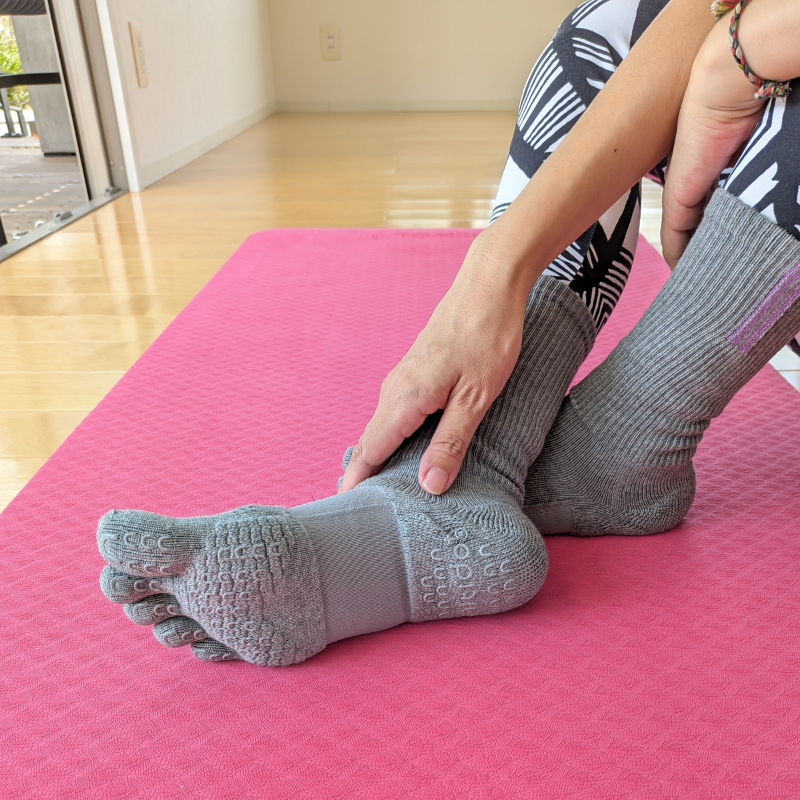

Many people may feel a decline in their physical strength, finding themselves easily fatigued during long periods of standing or walking, or struggling with balance during Pilates or running. Additionally, many suffer from foot problems such as flat feet or bunions.
While it is known that five-toe socks allow the toes to move freely, what is surprisingly less known is how "support functions" work and how they support the feet. This article focuses on the arch support, cushioning, and non-slip features adopted by Knitido+, a specialized brand for five-toe socks. We will explain their characteristics and provide tips on how to choose the right socks for daily life and exercise.
What are the "support" functions of five-toe socks?

In five-toe socks, "support" functions refer to designs and reinforcement features that support the structure and movement of the foot, enhancing comfort, stability, and performance.
Typical examples include:
-
・Arch support: A function that lifts and supports the arch of the foot.
-
・Air cushion: Reduces impact on the foot upon landing.
-
・Non-slip (grip): Helps maintain a firm stance.
-
・Ankle support: Secures the ankle area with a compression structure to prevent joint instability and twisting.
These functions address concerns such as foot fatigue and instability, facilitating more comfortable walking and exercise.
The importance of the foot arch
Essential for foot support is the function of the arches on the sole of the foot. The arches serve as the foundation that supports the body, deeply influencing posture and movement stability. This chapter explains the roles of the three arches and offers tips for maintaining healthy feet.
The role of the three arches on the sole of the foot

There are three arches on the sole of the foot: the medial longitudinal arch (instep), the lateral longitudinal arch, and the transverse arch.
■ Medial longitudinal arch

Composed of the calcaneus, talus, navicular, cuneiforms, and metatarsals. This is the highest arch, and it absorbs impact during walking and running, acting like a cushion.
■ Lateral longitudinal arch

Composed of the calcaneus, cuboid, and fifth metatarsal. It serves as the "base" that supports the body and maintains stability.
■ Transverse arch

A dome-shaped arch connecting the bases of the toes. It distributes weight and maintains balance by allowing smooth toe movement.
The three arches work together to absorb impact from the ground across the entire sole of the foot, distributing weight efficiently to support the body, and enabling smooth movements like standing, walking, and running.
Problems that can occur when the arch collapses
When the arch collapses, the distribution of force on the sole of the foot becomes uneven, which can lead to discomfort. If this condition persists, it may affect not only the feet but also posture and movement.
Common symptoms include:
-
・Flat feet
-
・Bunions
-
・Heel pain
-
・Knee discomfort
-
・Lower back issues
If you experience fatigue easily during long periods of standing or walking, it might be related to the balance of your foot arches. Paying attention to your foot arches in daily life and actively moving your feet can lead to healthier, more comfortable feet.
Support functions that "adjust" rather than "brace"
To protect the foot arches, it is essential to adjust them through movement rather than bracing them rigidly. By naturally using the muscles of the sole and toes, you can enhance the foot's inherent flexibility and sense of balance.
Five-toe socks, with their individual toe design, allow for free movement and can help naturally adjust the arch function during daily activities. Cultivating an awareness of your feet and creating an environment where the toe and sole muscles can move is the first step toward maintaining healthy arches.
What types of "support functions" does Knitido offer?

Knitido's five-toe socks feature various support functions designed to work with the foot's movements. Arch support, air cushioning, non-slip features, and compression designs each contribute differently to supporting the foot.
1. Arch Support Function
Arch support is one of the signature features of Knitido's five-toe socks. By combining stretchy material in the midfoot, it creates a structure that effectively supports the three arches of the foot (medial, lateral, and transverse).
This design gently conforms to the foot's movements, supporting stability during walking. It is designed to allow the sole of the foot to move naturally even during long periods of standing or exercise. With a fit that adapts to the foot's shape and movement, it enhances overall foot comfort.
2. Air Cushion
The patented (Patent No. 6415680) air cushion is a unique Knitido technology. Cushions placed at the forefoot, midfoot, and heel each absorb impact from the ground, supporting comfort during walking and exercise.
This feature ensures comfort even in activities that place significant stress on the feet, such as running and walking. It is a thoughtfully designed function that gently supports the foot while valuing the sensation of the sole.
3. Non-slip (Grip)
The non-slip function is highly effective in activities like Pilates and yoga, where foot sole sensation is crucial. Grips placed across the entire sole prevent slipping on mats or machines, aiding stable movements.
The grip allows for a firm push-off with the toes and provides a sense of security. It helps create an environment where you can concentrate on your movements without slipping, even when sweating. Among these, the "Core Grip" series features an enhanced grip thickness design, popular among those seeking greater stability.
4. Compression Design
Knitido+'s compression design fits snugly from the ankle to the midfoot. Its three-dimensional knitting method gently supports the arch and ankle area, preventing the socks from slipping. Rather than tight constriction, it naturally holds the foot in place with movement, making it convenient for prolonged wear.
Additionally, items featuring a patented manufacturing method (Patent No. 5377088) that avoids using elastic thread at the opening leave no marks on the leg even after long hours of wear, maintaining a comfortable fit. With its enveloping fit, it comfortably supports daily life.
Why experts recommend them: The enhanced foot stability that comes from "support"

Firmly creating and aligning the arch of the foot is essential for maintaining overall body stability. The presence or absence of an arch is said to affect standing posture, weight distribution during walking, and movement fluidity.
This chapter introduces what experts perceive as "the meaning of supporting the foot."
The appeal of five-toe socks, recommended by experts for daily use
A distinctive feature of five-toe socks is their ability to allow each toe to move independently. This enhances the ability to grip the ground, naturally encouraging the use of the sole muscles.
Kōsuke Morinaga, a lecturer at Hiroshima International University's Department of Comprehensive Rehabilitation, states that "freely moving the toes is important for strengthening the plantar muscles." Ai-ren Song, a Pilates instructor, says she feels a "noticeable difference in foot fatigue" when wearing five-toe socks and uses them daily.
Pilates instructor on the importance of "foot sensation"
In Pilates, the sensation derived from the soles of the feet is considered directly linked to overall body stability. For this reason, many instructors believe "barefoot is best." However, studio floors can be slippery or cold, making movement difficult.
Takeshi Funakoshi, representative of Pilates Studio DEP, says, "The sensation of the sole of the foot is connected to the entire body. For those whose foot condition is not optimal, the support function of socks can be helpful." Five-toe socks support the arch, preventing foot instability and promoting more stable movements.
By preventing coldness and slipping while enhancing foot sensation, five-toe socks are a reliable ally for improving movement quality.
Physical therapists focus on the meaning of "supporting the arch"
Physical therapists, as body specialists, believe that arch collapse affects not only the feet but also posture and stress on the knees and lower back. Yasunari Shuda, who transitioned from a physical therapist to a Pilates instructor, states, "It's important to focus on building a body that doesn't easily break down, rather than trying to fix it after it's already deteriorated."
Shuda himself feels that wearing five-toe socks has reduced unnecessary strain and made him less tired even after long periods of standing. The gentle support function for the soles of the feet helps promote natural posture and movement, serving as a foundation for a healthy daily life.


