


Pilates has recently attracted attention as an exercise perfect for those who want to build a healthy body, from improving posture to strengthening their core. However, some people may be wondering about the difference between Pilates and yoga, and the benefits they can gain.
Unlike yoga, Pilates has basic movements, and by mastering them and combining them with breathing techniques, you can more effectively increase your flexibility.
This article will explain in detail what Pilates is, its characteristics, expected effects, differences from yoga, and appropriate attire.
What is Pilates?

Pilates is an exercise developed by German nurse Joseph H. Pilates for the rehabilitation of soldiers injured in World War I. Since it allows people to move their bodies without strain, even when lying down, it became known as an exercise that could prevent muscle atrophy and alleviate lack of exercise.
It first spread among dancers and athletes. It gained attention because it strengthens the deep inner muscles of the body and balances the entire body, leading to beautiful posture and graceful movement. Since then, it has spread to the general public and is now a popular exercise worldwide.
Types of Pilates
There are two main types of Pilates: mat Pilates and machine Pilates.
- ・Mat Pilates: Performed on a mat using your own body weight. Can be easily done at home.
- ・Machine Pilates: Performed using specialized equipment. The machine supports the body, allowing for efficient strengthening of the inner muscles.
Characteristics of Pilates
Pilates is an effective exercise for building a healthy body. It is said to have positive effects on both the physical and mental aspects, and the third Pilates boom began around 2020. So, what are the specific characteristics of Pilates?
■ Emphasizes inner muscles
Pilates' main goal is to strengthen the deep inner muscles of the body. Inner muscles are a general term for the deep muscles of the body and play a role in supporting the core.
■ Conscious of correct body alignment
Alignment is a Pilates term that refers to "checking whether the body is symmetrical and balanced." In Pilates, it is very important to be conscious of correct body alignment (the arrangement of bones, joints, muscles, etc.). This is checked during poses and movements. By performing each movement precisely, muscle and skeletal balance is restored, allowing you to walk without tilting in daily life.
■ Performed with thoracic breathing
Pilates is performed with thoracic breathing. Thoracic breathing is a method of expanding the ribs using the intercostal muscles to take in a large amount of air into the upper part of the lungs. This increases heart rate and promotes blood flow, activating the sympathetic nervous system. When the sympathetic nervous system is activated, the autonomic nervous system is more easily regulated.
■ Emphasizes spinal movement
Pilates also emphasizes improving spinal flexibility. Improving spinal movement smooths nerve flow, promotes overall health, and makes it easier to balance the autonomic nervous system.
■ Increases body awareness
Pilates is an exercise that involves facing your body and being conscious of each muscle. By increasing your awareness of your body, which you don't usually pay attention to, your sense of body movement becomes sharper.
Benefits of Pilates

Pilates has positive effects on both mind and body, and is expected to bring about positive changes. Let's look specifically at what effects it has on the physical and mental aspects.
Physical Aspects
■ Balances the entire body
Strengthening the inner muscles stabilizes the core, efficiently balancing the entire body.
■ Injury prevention and improved movement efficiency
By acquiring correct alignment and balancing muscles and bones, equilibrium is gradually achieved. Maintaining good posture also reduces the risk of injury and improves the efficiency of daily movements.
■ Activation of internal organs, nerves, and brain
When the sympathetic nervous system becomes dominant through thoracic breathing, the amount of oxygen supplied to the brain increases, which is expected to enhance concentration and attention. Additionally, thoracic breathing stimulates the sympathetic nervous system, which also has the effect of improving basal metabolism. This increases energy consumption, making it easier for fat to be burned.
Mental Aspects
■ Autonomic nervous system regulation effect
The slow breathing performed in Pilates has a stress-reducing effect, so many people engage in it for mental and physical stability. Additionally, by consciously moving the muscles around the spine, the function of the nerves running through the spine is activated. This helps to regulate the autonomic nervous system, leading to overall health improvement from within the body, such as regulating organ function and normalizing hormone secretion.
■ Stress relief and mental and physical stability
Thoracic breathing, used in Pilates, is a breathing technique that activates the sympathetic nervous system. When the sympathetic nervous system is dominant, adrenaline is released, allowing for a positive and active state of mind. In contrast, the parasympathetic nervous system becomes dominant when the body and mind are in "rest mode," such as after a bath or before bed.
■ Improved body awareness and posture
By increasing your awareness of your own body, your awareness of body usage and posture in daily life will improve, naturally leading to the maintenance of beautiful posture.
Benefits of Pilates

Pilates offers various benefits. Understanding these can help you clarify your training needs and efficiently reach your goals.
1. Improved Flexibility
Strengthening the inner muscles, a focus of Pilates, can also be expected to increase joint range of motion. Regular practice is said to make the body more flexible and daily movements easier. Additionally, when the inner muscles are strengthened, the balance of all muscles in the body improves, leading to increased flexibility.
2. Improved Immunity
The breathing techniques used in Pilates promote blood flow, allowing oxygen and nutrients to circulate more easily throughout the body, which is expected to activate immune cells. Additionally, deep breathing has a stress-reducing effect and is believed to mitigate the negative impact of stress on immunity.
3. Weight Loss Effect
Strengthening your inner muscles increases your basal metabolism, making it easier to lose weight. Strengthening your core also improves your posture, leading to a more toned appearance. By continuing Pilates, you will notice changes not only in your weight but also in your body shape. However, instead of seeking dramatic changes in a short period, it is important to engage in it regularly with a long-term perspective.
4. Swelling Improvement
Pilates exercises have the effect of promoting blood and lymph circulation. When the muscles in the lower body are strengthened, the muscle pump action is activated, which can help reduce swelling. In particular, strengthening the calf muscles, often called the "second heart," improves blood flow, making it easier for excess fluid to be expelled from the body.
5. Improvement of Cold Sensitivity
Stimulating the inner muscles promotes muscle activity to raise body temperature and improves blood circulation. Twisting movements and consciously using specific muscles can improve blood flow to internal organs, which can help alleviate poor circulation that causes cold sensitivity. As basal metabolism increases, overall energy consumption in the body rises, making it easier to develop a body that is less susceptible to cold.
6. Injury Prevention
Continuing Pilates improves joint flexibility and stability, which also leads to injury prevention. Increased stability in the hips and spine allows for safer movements in sports and daily life.
What is the effective frequency for Pilates?

To truly feel the benefits of Pilates, it is generally recommended to practice at least twice a month. It is said that you will notice effects after 10 sessions, and feel physical changes after 30 sessions.
The important thing is to continue at your own pace without overdoing it.
Pilates vs. Yoga
Both Pilates and yoga are exercises that have positive effects on the mind and body, but there are several differences.

Appropriate Attire for Pilates

For Pilates, we recommend comfortable clothing that does not restrict movement.
■ Tops
T-shirts or tank tops that are not too tight are recommended. Choose a length that is not too short so as not to interfere with movement. Sweat-absorbing and quick-drying materials will keep you comfortable even when you sweat.
■ Bottoms
Choose a material that is stretchy and easy to move in. It is recommended that the waist is not too tight. Leggings come in various types. For example, choose from 7/8 length, ankle length, full length, etc., according to your preference.
■ Socks
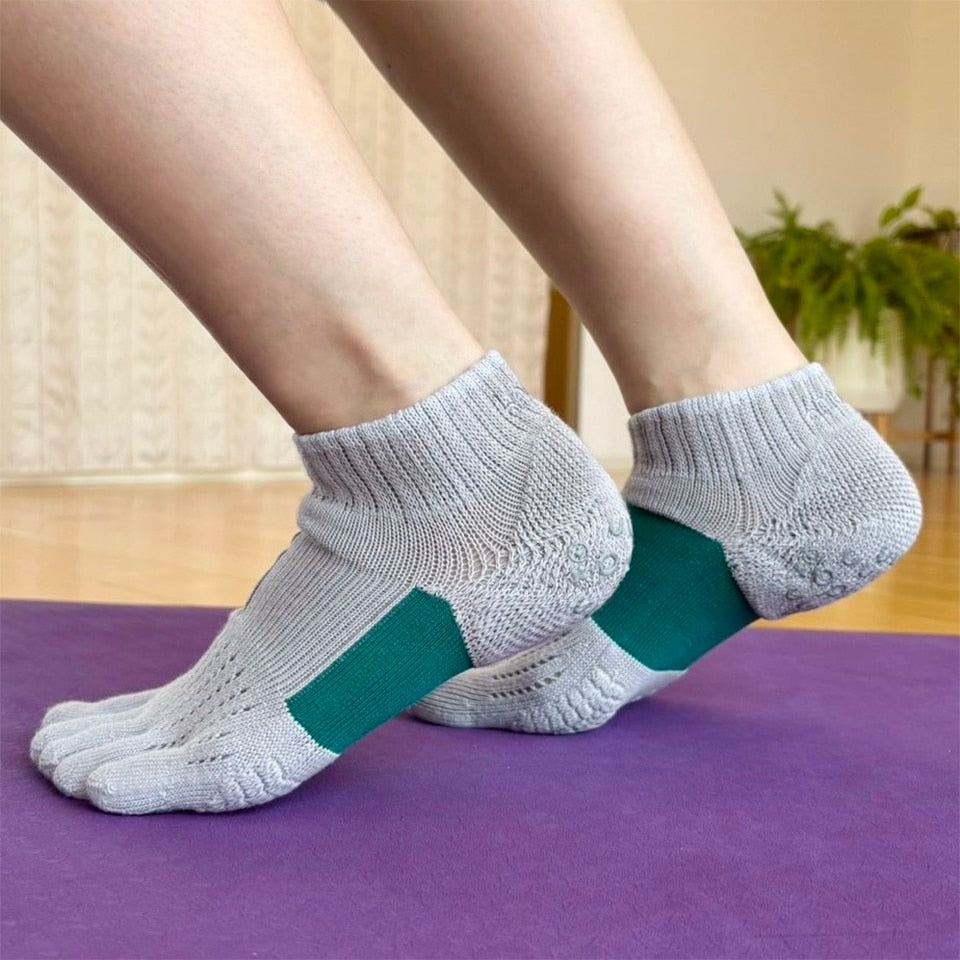
Wearing socks is recommended for Pilates. In particular, wearing socks with non-slip grips can increase stability on mats and equipment, allowing for safe movements, and also offers the hygienic benefit of avoiding direct contact with the floor. When choosing socks, opt for those with a moderate thickness, non-slip grips, and a good fit.
Benefits of Five-Toe Socks in Pilates

Five-toe socks allow each toe to move independently, providing a better grip than regular socks. Each toe is free, enabling you to exercise in a more stable posture.
In this chapter, we will introduce the benefits of five-toe socks for a more enjoyable Pilates experience.
1. Improved Balance
Five-toe socks allow your toes to move independently, giving you a firm grip on the ground. Feeling the ground with the soles of your feet also increases foot stability. This will make it easier to maintain a better posture.
2. Enhanced Grip Strength
Five-toe socks also play a significant role in supporting the intricate movements required in Pilates. By choosing socks with grips on the sole, you can enhance pose stability and maintain good balance. A strong grip also helps prevent injuries and improves exercise performance.
3. Cold Protection
Five-toe socks are designed to individually enclose each toe, so they can be expected to have a high heat retention effect. While your feet may get cold when doing Pilates in winter or in an air-conditioned room, wearing five-toe socks can help maintain your foot temperature and prevent coldness. On cold days, using them with leg warmers will keep your feet warm and toasty.
Knitido's 5-toe socks are high-performance and incredibly comfortable.
Knitido also offers series of 5-toe socks that employ a fully seamless flat knitting machine. A fully seamless flat knitting machine is an innovative piece of equipment that can create three-dimensional shapes in a single knit. This allows for the production of socks with absolutely no seams, resulting in a comfortable fit.
Knitido's Recommended 5-Toe Socks

The ankle-length "THREE Bi-Color Ankle" features a bi-color design combining plain knit and rib knit, providing a cool and comfortable fit. It is equipped with an air cushion that lifts the arch of the foot and an original grip, and the air cushion in the center of the forefoot helps support beautiful posture by lifting the center of gravity. With its simple design, it can be used in a wide range of situations, from Pilates, yoga, and training to everyday outings.


THREE Bicolor Ankle

The "FIVE Marble Ankle" is equipped with features to support Pilates movements, featuring strong stretch material in the arch of the foot for stable footwork. It can be used in a wide range of athletic activities such as Pilates, yoga, and training.


FIVE Marble Ankle

The "BOTA Border Open," featuring an appealing pastel-colored striped pattern, has a rounded open design on the instep, making your feet look sleek and beautiful. A total of three air cushions placed in the midfoot and arch support a stable standing posture, and non-slip grips on the entire sole allow you to exercise with confidence. It is an excellent choice for a wide range of uses, from Pilates and yoga to everyday sandal wear.


Summary
Pilates is an exercise that strengthens the inner muscles and balances the entire body, leading to various benefits such as improved posture, increased flexibility, weight loss, and stress reduction. By strengthening the core, which is the axis of the body, posture stabilizes and the body's overall balance improves. Another good aspect is that anyone can do it regardless of age or fitness level. Five-toe socks are an item recommended by many instructors to enhance the effects of Pilates. Simply wearing them increases toe freedom, improves balance, and strengthens grip, making it easier to feel the benefits.
Let's make Pilates even more enjoyable with comfortable clothing and five-toe socks.


